Updated: Sep 5, 2025
Regulatory Affairs in African Pharma – Compliance, SAHPRA & Market Entry
Introduction
Regulatory Affairs (RA) is the multidisciplinary profession that ensures medicines, vaccines, medical devices and other health products are developed, assessed, authorised and maintained in line with statutory requirements. For companies operating in, or entering, South Africa and the broader African market, a robust RA strategy is the difference between timely patient access and costly delays.
What is Regulatory Affairs?
RA is the discipline that ensures every stage of product development from pre-clinical studies to post-marketing surveillance complies with prevailing laws, guidelines and ethical standards. Professionals in this field liaise with regulators, prepare technical dossiers and monitor changes in legislation to maintain ongoing compliance. Globally accepted frameworks such as ICH guidelines, Good Laboratory/Clinical/Manufacturing Practice (GLP/GCP/GMP) and the Common Technical Document (CTD) underpin most submissions.
History
Regulatory affairs emerged in the 1960s after a series of drug-safety crises underscored the need for stringent oversight. Today it bridges science, law and business, translating complex statutes into actionable pathways that protect patients while enabling innovation.
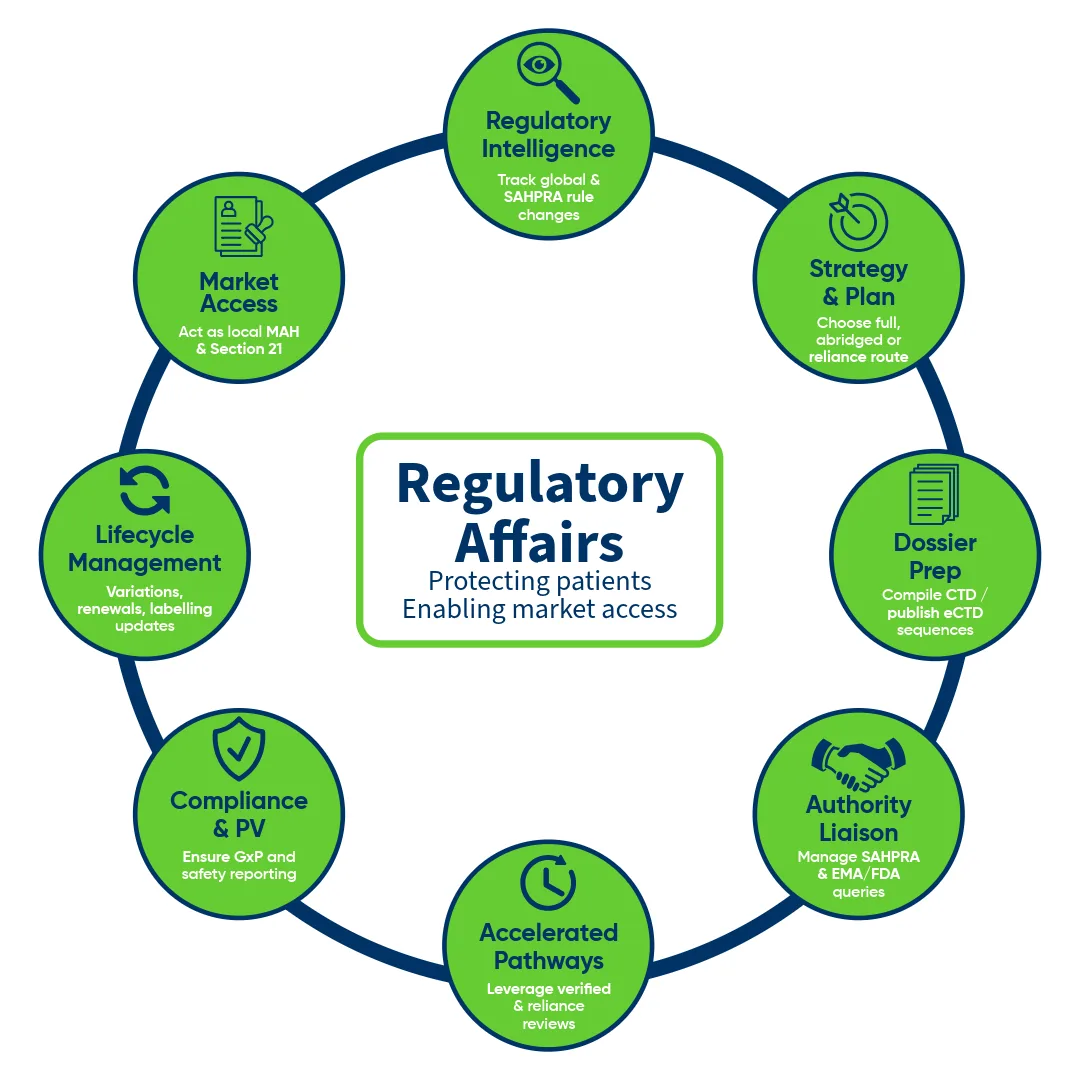
What Regulatory Affairs Involves
| Pillar | Typical activities |
|---|---|
| Regulatory intelligence | Tracking legal changes (e.g., SAHPRA’s 2025–26 Performance Plan) (sahpra.org.za) |
| Strategy | Selecting full, abridged or reliance review; planning data packages (ICH CTD) (au.int) |
| Dossier preparation | Compiling Modules 1–5; formatting to eCTD for SAHPRA portal (ectd.sahpra.org.za) |
| Authority liaison | Responding to SAHPRA, FDA, EMA questions; negotiating timelines (sahpra.org.za) |
| Lifecycle management | Variations, renewals, pharmacovigilance, labelling updates (sahpra.org.za) |
Key Frameworks
- SAHPRA – Medicines & Related Substances Act 101/1965; risk-based and reliance review models cut median approval from 26 months to <18 months.
- Collaborative Frameworks include:
- Recognised Regulatory Authorities (RRAs) including EU CP, EU DCP, EMA national/MRP, US FDA, Health Canada, MHRA (UK), PMDA/MHLW (Japan), SwissMedic, TGA (Australia), WHO-listed authorities, and others listed in the guideline.
- ZaZiBoNa is a work‑sharing framework in which participating national regulators retain sovereign decision‑making, but rely on a common technical evaluation and harmonised standards to reduce duplication, shorten timelines and build regulatory capacity across the region
- WHO collaborative registration procedures: WHO prequalification collaborative registration for PQ products and WHO SRA‑approved collaborative mechanisms
- EU and Swiss collaborative mechanisms: EMA mutual recognition and national procedures, and SwissMedic’s MAGHP (Marketing Authorisation for Global Health Products) procedure
- African Medicines Agency (AMA): use of AMA structures and procedures as an additional reliance/collaborative route once operational.
- EU‑M4all and other global‑health programmes: reliance on EU‑M4all decisions and similar mechanisms to support registration of global‑health products.
- ICH & WHO – Provide global CTD, GxP and pharmacovigilance standards adopted by African regulators.
Why Regulatory Affairs Is Critical
- Patient safety & public trust — Only products proven safe, effective and high-quality reach the market.
- Commercial timelines — Each month of delay can cost a novel drug US$1–2 million in lost sales.
- Risk mitigation — Non-compliance triggers recalls, fines and reputational damage.
- Market access — Reliance pathways let SAHPRA accept FDA/EMA assessments, trimming dossier review by 30-40 %.
- Continental harmonisation — AMA will enable mutual recognition, reducing duplicate filings.
The African Context: Challenges & Opportunities
| Challenge | Impact | Emerging solution |
|---|---|---|
| Fragmented national rules | Individual Dossier submission per country to address regional requirements. | AMA work-sharing & SADC/ZAZib reliance routes (au.int) |
| Historic SAHPRA backlog | Launches >2 years behind US/EU | Risk-based & verified reviews; eCTD portal (sahpra.org.za, ectd.sahpra.org.za) |
| Need for local MAH | Foreign Principals to comply with national Licence requirements, | Contract MAH model under Section 22C (MC Pharma) |
| Post-market vigilance | Resource-heavy | Outsourced PV & QMS aligned to WHO UMC (sahpra.org.za) |
How MC Pharma Adds Value
Licensing & representation
MC Pharma is licensed under Section 22C(1)(b) to act as Applicant and Marketing-Authorisation Holder, removing the need for a foreign subsidiary to establish a legal presence in the area.
eCTD authoring & publishing
In-house suite converts global CTDs into SAHPRA-ready eCTD sequences, performs XML validation and manages lifecycle updates
Strategic regulatory planning
The team prepares reliance-route justifications, gap analyses and dossiers tailored for abridged or verified review, shortening approvals.
Section 21 permission for unregistered medicines (SA)
MC Pharma (acting as a Section 21 Co-Applicant) can facilitate the application process, regulatory compliance and logistics for unregistered-medicine imports in terms of Section 21, enabling medicine access for the Healthcare Provider.
Quality & supply chain
MC Pharma can link Principals with GDP-compliant distribution via a vetted network of four distributors and 35 wholesalers.
Regulatory-Affairs Careers and Job Roles
Regulatory-affairs (RA) careers span from entry-level officers who compile dossiers to senior executives who direct global compliance strategy. Demand is strong in South Africa, the UK/EU and worldwide as regulators tighten oversight and companies accelerate new-product launches. Typical progression is:
- RA Assistant
- RA Associate
- RA Officer / RA Pharmacist
- RA Specialist
- Senior RA Specialist/RA Project Manager
- RA Manager / Head of RA
- RA Director / Responsible Pharmacist
Core Skills Include:
- Scientific literacy
- Dossier authoring
- Negotiation
- Project management
Emerging niches:
- RegTech implementation
- AI-enabled data analysis
CMC variation strategy and post-market vigilance are creating hybrid roles that blend IT with traditional RA expertise. MC Pharma’s Section 22C licence, eCTD infrastructure and continent-wide client base give professionals exposure to multiple markets.
Typical Job Titles & Progression
| Level | Representative titles | Primary focus |
|---|---|---|
| Entry (0-2 yrs) | Regulatory Affairs Officer / Associate | Data gathering, eCTD formatting, basic variations |
| Early career (2-5 yrs) | RA Specialist / Analyst | Dossier authoring, literature review, responding to minor SAHPRA RFIs |
| Mid-career (5-8 yrs) | Senior Specialist / Project Manager | Leads submissions, cross-functional liaison, mentors juniors |
| Management (8-12 yrs) | RA Manager / CMC Manager | Portfolio strategy, resource planning, regulator negotiation |
| Senior leadership (>12 yrs) | Director / Senior Director | Global policy, risk governance, authority engagement at senior level |
| Executive | Head of Regulatory Affairs / Responsible Pharmacist / Qualified Person (QP) | Corporate compliance vision, M&A diligence, board reporting |
Core Responsibilities by Seniority
- Officers & Associates – assemble CTD modules, track regulatory intelligence, create label text
- Specialists – write scientific justifications, prepare variation and renewal packages, co-ordinate with QA and PV teams
- Managers – craft submission strategies (full vs. reliance), budget regulatory projects, manage authority meetings
- Directors/RP/QP – set global policies, oversee inspection readiness, integrate regulatory input into corporate strategy
Competencies & Qualifications
| Category | Key requirements |
|---|---|
| Education | BSc/PharmD/MBChB minimum; MSc Regulatory Science or RAC credential highly valued |
| Technical skills | eCTD publishing, GxP knowledge, CMC change control, PV systems |
| Soft skills | Analytical thinking, clear writing, stakeholder negotiation, attention to detail |
Market Outlook
Industry surveys project a compound annual growth rate of 5–7 % in global RA head-count through 2030, driven by expanding regulatory frameworks and harmonisation initiatives such as the African Medicines Agency (RAPS, 2024). Digitalisation, reliance pathways and AI-assisted dossier preparation are expected to accelerate both demand and role diversification with associated increasing cost of compliance.
Emerging & Specialised Roles
| Niche role | Drivers |
|---|---|
| RegTech Implementation Lead | Deploys AI/ML tools for automated vigilance reporting and compliance analytics |
| CMC Variation Strategist | Manages post-approval changes across multi-country filings |
| Label & Artwork Compliance Manager | Oversees digital artwork management and UDI/2D-barcode mandates |
| AI-Assisted Regulatory Data Scientist | Uses LLMs to interrogate clinical and quality data for rapid response dossiers |
| Reliance Pathway Advisor (Africa) | Navigates SADC/AMA work-sharing to cut review times by 30–40 % |
Conclusion
Regulatory Affairs is both a public-health safeguard and a strategic business lever. As SAHPRA modernises and collaborative harmonisation gathers pace, companies that embed African-centred RA early - and partner with licensed experts like MC Pharma - will reach patients sooner, stay compliant longer and build sustainable market leadership.
Focused, High-Volume GLOBAL FAQs on Regulatory Affairs
| Question | Answer |
|---|---|
| 1. What is regulatory affairs in the life-sciences sector? | Regulatory affairs (RA) is the profession that interprets and applies government regulations to ensure that medicines, medical devices, cosmetics and related products are researched, manufactured, distributed and monitored in compliance with safety, quality and efficacy standards (topra.org, abpi.org.uk). |
| 2. Why is regulatory affairs important to public health and to companies? | RA protects patients by preventing unsafe or ineffective products from reaching the market and saves companies time and money by guiding them through compliant development and approval pathways, thereby avoiding costly delays, recalls or legal penalties (synergbiopharma.com, abpi.org.uk). |
| 3. What does a regulatory affairs specialist do on a day-to-day basis? | Typical tasks include tracking regulatory updates, compiling and publishing Common Technical Document (CTD/eCTD) dossiers, submitting variations, liaising with authorities (e.g., SAHPRA, EMA), reviewing labels, ensuring marketing compliance and coordinating with quality, clinical and pharmacovigilance teams (graduate.northeastern.edu, careerinpharma.com). |
| 4. What qualifications and skills are needed to enter regulatory affairs? | Most entry roles require at least a Bachelor of Science, Pharmacy or Engineering degree; postgraduate certificates (e.g., MSc Regulatory Science) or the RAPS RAC credential add advantage. Essential skills include scientific literacy, attention to detail, clear technical writing, project management and negotiation (indeed.com, mhaonline.com, raps.org). |
| 5. How does regulatory affairs differ from quality assurance (QA)? | RA ensures products meet external legal and regulatory requirements and obtains market authorisations, whereas QA focuses on internal systems that keep manufacturing and testing processes consistently within predefined quality standards. Both collaborate, but RA is outward-facing to regulators while QA is inward-facing to production operations (graduate.northeastern.edu, indeed.com). |
Works Cited
- African Union. (2025). High-level working breakfast on operationalising the African Medicines Agency (AMA). https://au.int
- BioBoston Consulting. (2024). The crucial role of regulatory affairs in the product lifecycle. Retrieved July 7 2025.
- Food & Drug Administration. (2024). Drug recalls, withdrawals & safety alerts. https://www.fda.gov
- Ndlovu, S., et al. (2023). Implementation of a risk-based assessment by SAHPRA. Therapeutic Innovation & Regulatory Science, 57(4), 589-599. https://pubmed.ncbi.nlm.nih.gov
- SAHPRA. (2025). Annual performance plan 2025–2026. https://www.sahpra.org.za
- SAHPRA. (2024). eCTD portal user guide. https://ectd.sahpra.org.za
- SAHPRA. (2025). Guideline 2.24 – Submission of ZA-CTD/eCTD applications. https://www.sahpra.org.za
- Topra. (2024). What is regulatory affairs? https://www.topra.org
- World Health Organization. (2024). Good pharmacovigilance practices. https://www.who.int
- MC Pharma. (2024). Company profile (Internal document).
Contact MC Pharma for Your Regulatory Affairs Needs
Why choose MC Pharma?
With over 26 years of experience in navigating South Africa’s complex regulatory landscape, MC Pharma is your strategic partner for patient safety, regulatory excellence, and market success.
📞 +27 (012) 668 3019
✉️ pharmacist@mcpharma.co.za
🌐 Visit our website