Updated: Sep 5, 2025
Pharmacovigilance in South Africa: How MC Pharma Safeguards Your Safety
Introduction
In the highly regulated pharmaceutical industry, ensuring safety, efficacy, and quality of medicines is paramount. This process does not end at product registration but continues throughout the entire lifecycle of a medicine. The ongoing vigilance is known as Pharmacovigilance.
For companies entering or operating in the South African pharmaceutical market, pharmacovigilance is not just a regulatory obligation — it is an ethical responsibility. At MC Pharma, we serve as your trusted partner in navigating these critical safety requirements, offering end-to-end pharmacovigilance solutions aligned with the latest SAHPRA (South African Health Products Regulatory Authority) regulations.

What is Pharmacovigilance?
Pharmacovigilance refers to the scientific and systematic process of detecting, assessing, understanding, and preventing adverse drug reactions (ADRs) or other drug-related issues. Globally recognised by the World Health Organization (WHO), pharmacovigilance aims to ensure that medicinal products remain safe and effective when used by patients under real-world conditions.
In South Africa, pharmacovigilance is governed by SAHPRA, which mandates that all licensed pharmaceutical companies and marketing authorisation holders (MAHs/Applicants) implement pharmacovigilance systems as per local regulatory requirements.
Source: SAHPRA Pharmacovigilance Guidelines
Why is Pharmacovigilance Important?
- Protects Patient Safety: Early detection and management of adverse drug reactions reduce the risk of serious health consequences.
- Regulatory Compliance: Compliance with SAHPRA is mandatory for maintaining market authorisation.
- Public Confidence: Builds trust with healthcare professionals, patients, and regulators.
- Risk-Benefit Monitoring: Continuous monitoring, trending and reporting ensures that the benefit-risk profile of a product remains positive throughout its lifecycle.
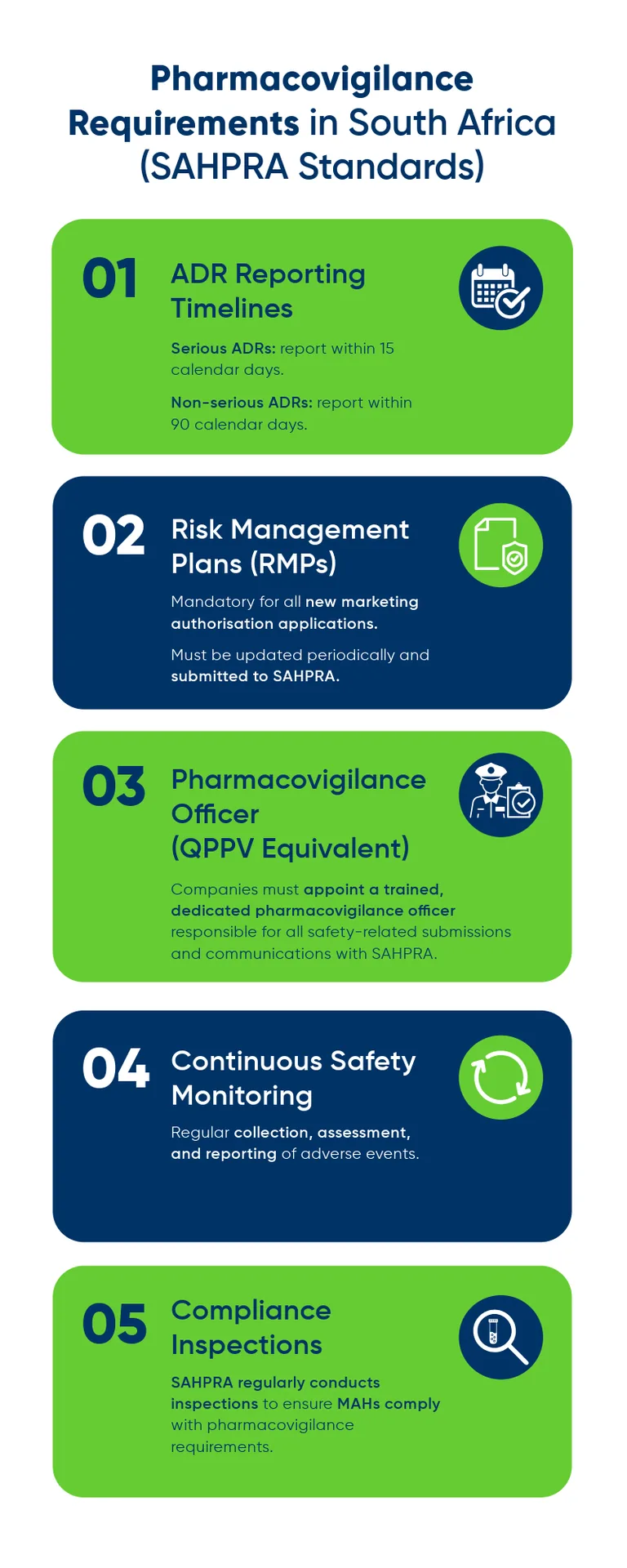
Pharmacovigilance Requirements in South Africa (SAHPRA Standards)
South Africa’s regulatory framework is aligned with ICH E2E global standards and WHO guidelines, while incorporating country-specific nuances:
- 1. ADR Reporting Timelines: Serious ADRs must be reported within 15 calendar days; non-serious ADRs within 90 calendar days.
- 2. Risk Management Plans (RMPs): Mandatory for all new marketing authorisation applications and must be updated periodically and submitted to SAHPRA.
- 3. Pharmacovigilance Officer (QPPV Equivalent): Companies must appoint a trained, dedicated pharmacovigilance officer responsible for all safety-related submissions and communications with SAHPRA.
- 4. Continuous Safety Monitoring: Regular collection, assessment, and reporting of adverse events.
- 5. Compliance Inspections: SAHPRA regularly conducts inspections to ensure MAHs comply with pharmacovigilance requirements.
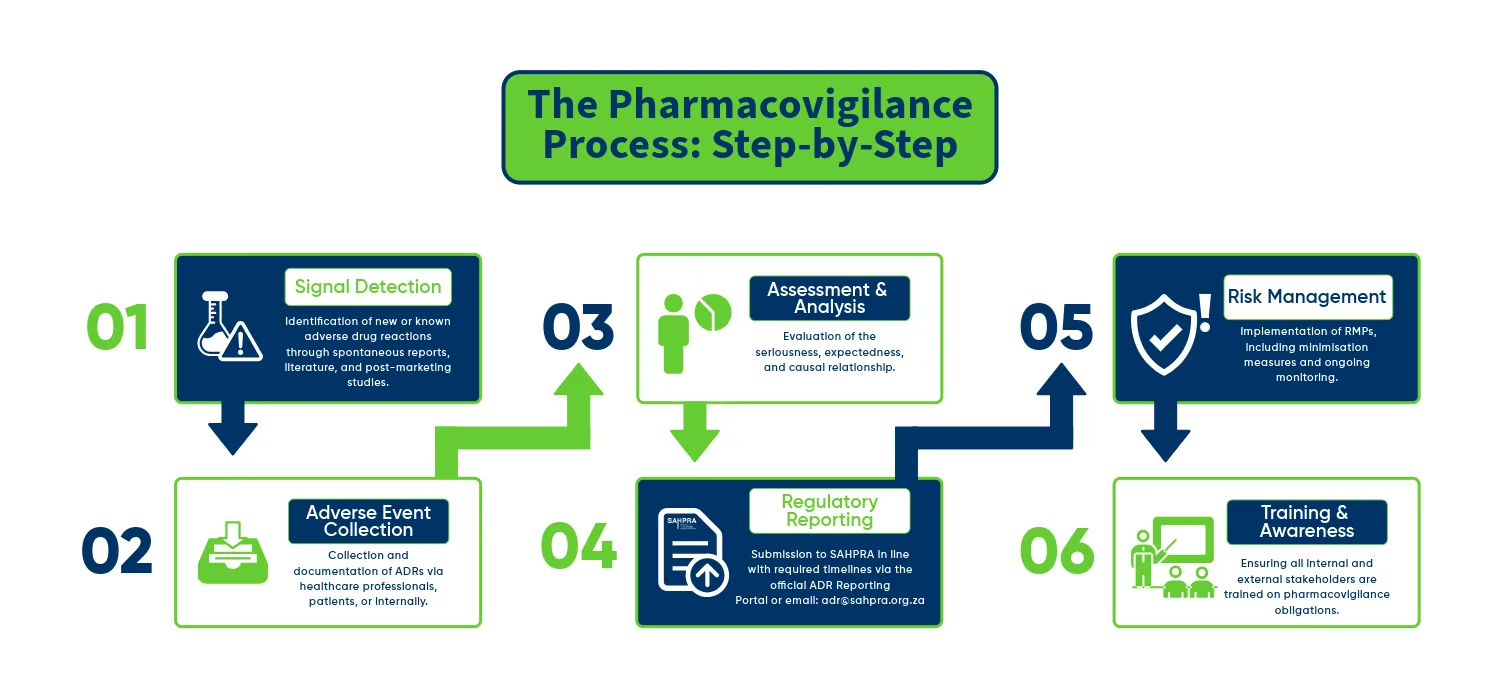
The Pharmacovigilance Process: Step-by-Step
- 1. Signal Detection: Identification of new or known adverse drug reactions through spontaneous reports, literature, and post-marketing studies.
- 2. Adverse Event Collection: Collection and documentation of ADRs via healthcare professionals, patients, or internally.
- 3. Assessment & Analysis: Evaluation of the seriousness, expectedness, and causal relationship.
- 4. Regulatory Reporting: Submission to SAHPRA in line with required timelines via the official ADR Reporting Portal or email: adr@sahpra.org.za.
- 5. Risk Management: Implementation of RMPs, including minimisation measures and ongoing monitoring.
- 6. Training & Awareness: Ensuring all internal and external stakeholders are trained on pharmacovigilance obligations.
MC Pharma's Pharmacovigilance Services
At MC Pharma, we offer an integrated pharmacovigilance solution that covers the entire regulatory and safety spectrum for companies entering or operating in the Southern African region.
Our Services Include:
- Acting as your official local Marketing Authorisation Holder (MAH) and QPPV.
- Establishing and maintaining SAHPRA-compliant pharmacovigilance systems.
- Risk Management Plan development, implementation, and maintenance.
- Management of local ADR collection, assessment, and reporting.
- Monitoring of regulatory safety data.
- Internal audits and regulatory compliance inspections.
- Pharmacovigilance training for your teams.
- SAHPRA liaison for all safety-related matters.
Why Choose MC Pharma?
With over 26 years of experience in navigating South Africa’s complex regulatory landscape, MC Pharma is your strategic partner for patient safety, regulatory excellence, and market success.
Best Practices for Implementing Pharmacovigilance
If you are an international or local pharmaceutical company planning to enter the Southern African market, these are essential steps:
- Establish a local pharmacovigilance system that meets SAHPRA requirements.
- Appoint a dedicated qualified pharmacovigilance officer or outsource to MC Pharma’s QPPV.
- Develop and maintain a robust Risk Management Plan (RMP).
- Implement internal SOPs governing ADR collection and reporting.
- Regularly update safety data and submit Periodic Safety Update Reports (PSURs).
- Train internal teams on pharmacovigilance obligations.
Recommended Resources
- SAHPRA Official Website
- WHO Pharmacovigilance Standards
- ICH E2E Pharmacovigilance Guideline
- MC Pharma Services Overview
Contact MC Pharma for Your Pharmacovigilance Needs
📞 +27 (012) 668 3019
✉️ pharmacist@mcpharma.co.za
🌐 Visit our website